Framework Analysis of Smart House based on Orange Technology use Systematic Literature
DOI:
https://doi.org/10.51903/jmi.v4i2.210Keywords:
Smart house , Framework, Systematic Literature , Analysis HouseAbstract
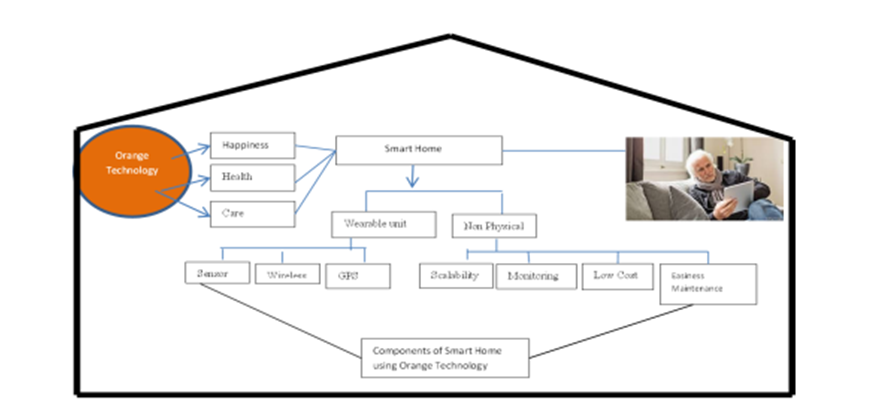
Now days, the home environment is still much less supportive of life for the elderly, most elderly living at home need a companion to help them. Safety, health, happiness and independence will be difficult for them to get even the elderly will be further away from the surrounding environment. Based on population projection 2017 data there are 23.66 million elderly people in Indonesia and predicted in 2020 there are 27.08 million people elderly. Smart homes that are currently widely studied have not focused on elderly; most smart homes only provide a sense of security and convenience for adult residents. And this will be a problem that until now has not solved the improvement of human life through technology to get happiness, care and health especially for the elderly. In many cases of the elderly, it is easier to send them to live in a nursing home and that keeps them separated from their families for the rest of their lives. That's what makes them less happiness. Orange Technology is a collection of technological elements to improve human life by getting happiness, Care and health. This study reviewed the journals of scientific databases such as IEEE explore, ACM digital library and Proquest published from 2002 to 2017. From the search results obtained 54 papers that will answer the scientific questions of this research. The result of this research is a framework of smart house that has Sensor, Monitoring, Wireless, Scalability, Low cost, GPS and ease of installation and maintenance as components of smart house of orange technology for elderly.
References
A. Altendorf and J. Schreiber, “Assistive technology in dementia care: Methodological issues in research design,” J. Assist. Technol., vol. 9, no. 1, pp. 38–47, 2015.
Arman, A., Prasetya, P., Arifany, F. N., Pradnyaparamita, F. B., & Laksito, J. (2022). A Digital Printing Application As An Expression Identification System. Journal of Technology Informatics and Engineering, 1(2), 5–15. https://doi.org/10.51903/JTIE.V1I2.135
A. Aspinall, “How can assistive technology and telecare support the independence and employment prospects for adults with learning disabilities?,” J. Assist. Technol., vol. 1, no. 2, pp. 43–48, 2021.
A. L. Bleda, F. J. Fernandez-Luque, A. Rosa, J. Zapata, and R. Maestre, “Smart Sensory Furniture Based on WSN for Ambient Assisted Living,” IEEE Sens. J., vol. 17, no. 17, pp. 5626–5636, 2019.
D. J. Brown, “Some uses of educational and assistive technology for people with disabilities,” Comput. Educ., vol. 56, no. 1, p. 56, 2011.
H. S. Al-Khalifa, M. Al-Twaim, M. Al-Mohsin, and M. Al Razgan, “Technologies Developed for Older Adults: Trends and Directions,” Commun. Comput. Inf. Sci., vol. 435 PART I, pp. 279– 283, 2020.
J. Abascal, B. Bonail, Á. Marco, R. Casas, and J. L. Sevillano, “AmbienNet: an intelligent environment to support people with disabilities and elderly people,” Proc. 10th Int. ACM SIGACCESS Conf. Comput. Access., pp. 293–294, 2021.
J. Berner et al., “Factors influencing Internet usage in older adults (65 years and above) living in rural and urban Sweden,” Health Informatics J., vol. 21, no. 3, pp. 237–249, 2019.
Li, Q., Diao, Y., Chen, Q., & He, B. (2022). Federated Learning on Non-IID Data Silos: An Experimental Study. Proceedings - International Conference on Data Engineering, 2022-May, 965–978. https://doi.org/10.1109/ICDE53745.2022.00077
M. A. O. Brien, W. A. Rogers, and A. D. Fisk, “Understanding Age and Technology Experience Differences in Use of Prior Knowledge for Everyday Technology Interactions,” vol. 4, no. 2, 2022.
Qin, Y. (2023). Semantic Role Labeling in Neural Machine Translation Addressing Polysemy and Ambiguity Challenges. Journal of Technology Informatics and Engineering, 4(1), 41–55. https://doi.org/10.51903/JTIE.V4I1.274
Santoso, J. T., Manongga, D., & Hendry, H. (2025). Decision support system in machine learning models for a face recognition-based attendance system. TELKOMNIKA (Telecommunication Computing Electronics and Control), 23(2), 371–381. https://doi.org/10.12928/TELKOMNIKA.V23I2.26412
Santoso, J. T., Wibowo, A., & Raharjo, B. (2024). Enhancement of Internal Business Process Using Artificial Intelligence. Jurnal Nasional Pendidikan Teknik Informatika (JANAPATI), 13(3). https://doi.org/10.23887/janapati.v13i3.79242
Santoso, J. T., Wibowo, A., & Sulartopo, S. (2024). THE EFFECT OF COVID-19 ON THE STABILITY OF THE FINANCIAL INDUSTRY. International Journal of Professional Business Review, 9(7), e02920. https://doi.org/10.26668/businessreview/2024.v9i7.2920
Wibowo, A. (2023). Layanan FinTech dalam Perspektif Hukum, Ekonomi, Teknologi (First). YPAT.
Wibowo, A., & Listyarini, D. (2023). Hukum Pemerintah.
Wibowo, A., & Santoso, J. T. (2024). Bottled Water Purchase Decisions: A Study of Brand Image as a Green Marketing Medium in Purchase Decisions. International Journal of Supply and Operations Management, 11(1), 83–99. https://doi.org/10.22034/IJSOM.2023.110194.2961
Downloads
Published
Issue
Section
License
Copyright (c) 2025 A. Sudrajat, Melyani Handoko, Zahra, Hendra Kurniawan, Didin Solehudin, Dian Indah Sari, Fazhar Sumantri

This work is licensed under a Creative Commons Attribution-ShareAlike 4.0 International License.