Determination of Employee Performance: Work Environment and Leadership Style : (Case Study at PT. MPIW Jakarta)
DOI:
https://doi.org/10.51903/jmi.v4i2.216Keywords:
Work Environment, Leadership Style, Employee Performance DeterminationAbstract
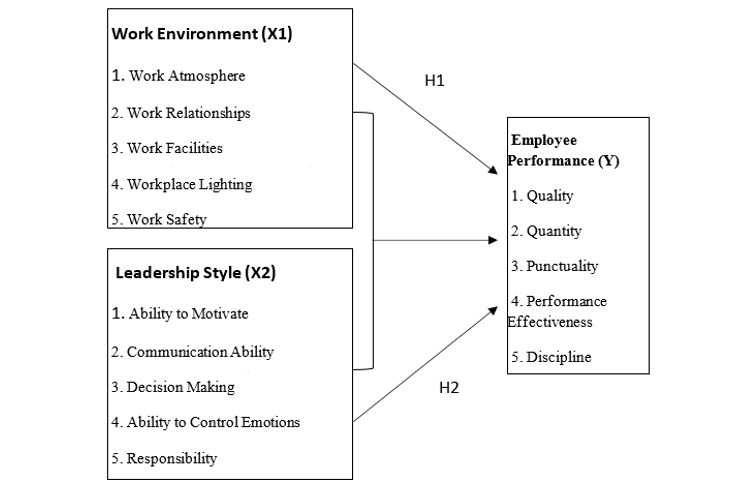
In today’s dynamic industrial environment, optimizing employee performance has become a strategic imperative for organizational sustainability. Among the factors that significantly influence workforce outcomes, the physical work environment and leadership style stand out as pivotal drivers. This study explores how these two variables affect employee performance within PT. MPIW, a prominent manufacturing firm in Jakarta. Employing a quantitative approach, data were obtained through structured questionnaires from 50 purposively selected respondents working in logistics, production, and purchasing divisions. Using IBM SPSS Statistics 21, the analysis revealed compelling insights. The work environment demonstrated a strong and positive influence on employee performance (t = 11.883, p < 0.001), affirming that factors such as spatial adequacy, safety, and interpersonal dynamics play a crucial role in enhancing productivity. Surprisingly, leadership style exerted a negative and statistically significant effect (t = -3.880, p < 0.001), suggesting that the prevailing authoritarian tendencies may undermine employee morale and engagement. The joint influence of both variables was also found to be significant (F = 86.518, p < 0.001), underscoring their combined relevance in shaping performance outcomes. This study contributes a critical perspective on organizational behavior in the manufacturing sector by integrating environmental and managerial dimensions into a unified analytical model. The findings underscore the need for adaptive, participatory leadership approaches and strategic enhancement of workplace conditions to drive sustainable performance improvements.
References
Al Khajeh, E. H. (2018). Impact of Leadership Styles on Organizational Performance. Journal of Human Resources Management Research, 2018, 1–10.
Bass, B. M., & Riggio, R. E. (2006). Transformational Leadership (2nd ed.). Psychology Press.
Elhoseny, M., & Shankar, K. (2020). Performance analysis of employee management systems using hybridized deep learning model. Neural Computing and Applications, 32(15), 11373–11385.
Irawan, S., Sari, A., Udaylana Putra, I. B., & Par, I. N. (2021). Pengaruh Lingkungan Kerja terhadap Kinerja Karyawan. Jurnal Ilmiah Manajemen dan Bisnis, 3(2), 25–35.
Malik, M. S., & Pathan, S. (2023). Role of Work Environment and Leadership Style in Improving Employee Performance: A Mediating Approach. Journal of Organizational Behavior Research, 8(1), 55–70.
Moleong, L. J. (2019). Metodologi Penelitian Kualitatif (Edisi Revisi). Remaja Rosdakarya.
Northouse, P. G. (2018). Leadership: Theory and Practice (8th ed.). SAGE Publications.
Nurpratama, I., & Yludianto, Y. (2022). Analisis Gaya Kepemimpinan Terhadap Kinerja Pegawai. Jurnal Ilmu Manajemen Terapan, 5(1), 47–58.
Rahmawati, Y., Ratnasari, S. L., Azis, H., Sutjahjo, S. H., & Winarso, W. (2023). Pengaruh Lingkungan Kerja terhadap Kinerja Pegawai. Jurnal Riset dan Inovasi Manajemen, 3(1), 18–25.
Raziq, A., & Maulabakhsh, R. (2015). Impact of Working Environment on Job Satisfaction. Procedia Economics and Finance, 23, 717–725. https://doi.org/10.1016/S2212-5671(15)00524-9
Sari, A., Udaylana Putra, I. B., & Par, I. N. (2021). Faktor-Faktor yang Mempengaruhi Lingkungan Kerja dalam Organisasi. Jurnal Ilmu Manajemen dan Bisnis, 3(2), 45–54
Sedarmayanti. (2017). Manajemen Sumber Daya Manusia: Reformasi Birokrasi dan Manajemen Pegawai Negeri Sipil. Refika Aditama.
Sihaloho, A. (2019). Pengaruh Gaya Kepemimpinan dan Motivasi terhadap Kinerja Karyawan. Jurnal Ilmiah Ekonomi dan Bisnis, 16(2), 34–45.
Sihombing, F., & Batoelbara, H. (2019). Pengaruh Lingkungan Kerja dan Budaya Organisasi terhadap Kinerja Karyawan. Jurnal Ilmu Manajemen Terapan, 3(1), 20–30.
Sriyana, Y. (2022). Analisis Faktor-Faktor yang Mempengaruhi Gaya Kepemimpinan. Jurnal Ekonomi dan Bisnis, 7(1), 12–21.
Sudiantini, N. M., & Saputra, I. W. (2022). Gaya Kepemimpinan Transformasional dalam Meningkatkan Kinerja. Jurnal Manajemen dan Bisnis Indonesia, 9(1), 67–76.
Tamba, J. (2018). Pengaruh Motivasi dan Lingkungan Kerja terhadap Kinerja Karyawan. Jurnal Ekonomi dan Manajemen, 6(2), 58–66.
Wahyuningsih, S. (2018). Lingkungan Kerja sebagai Determinan Kinerja Karyawan. Jurnal Ilmu Administrasi Bisnis, 6(3), 88–95.
Winata, L. A. (2022). Pengaruh Lingkungan Kerja terhadap Kepuasan Kerja. Jurnal Manajemen Indonesia, 11(1), 21–28.
Yeremia, N. A., Salfarini, E. M., & Beni, S. (2023). Gaya Kepemimpinan dan Pengaruhnya terhadap Kinerja Pegawai. Jurnal Ilmu Administrasi Publik, 10(1), 15–22.
Zaharuddin, M., Supriyadi, E., & Wahyuningsih, N. (2021). Pengaruh Gaya Kepemimpinan terhadap Kinerja. Jurnal Ekonomi dan Manajemen, 4(2), 87–95.
Downloads
Published
Issue
Section
License
Copyright (c) 2025 Faizal Roni , Melyani Handoko, Rd Bily Parancika, Mohammad Aris, Yahya Mara Ardi, Syabrinildi

This work is licensed under a Creative Commons Attribution-ShareAlike 4.0 International License.